Spring Bulb Planting After Garden Clearance: Planning Colour in Newark and Nottinghamshire Villages
Planting bulbs in autumn in Nottinghamshire? Here's exactly what to plant, when to get them in the ground, and how to set your garden up for a brilliant spring.

Autumn Is the Best Time to Set Your Garden Up for Spring
The hard work of spring colour happens in autumn. Get bulbs in the ground between September and November, and by the time February and March arrive, your borders and lawn edges are already doing something worth looking at. Leave it too late, or skip it altogether, and you spend next spring looking at bare soil wondering why everyone else's garden looks so good.
We work across Newark-on-Trent, Nottinghamshire and the surrounding villages all year round, and autumn is one of our busiest seasons. Alongside hedge tidy-ups, leaf clearance and border resets, we see a lot of gardens where bulb planting either gets done properly or gets forgotten entirely. The difference come spring is dramatic.
This guide covers what to plant, when to plant it, and how to do it right in Nottinghamshire conditions.
Which Bulbs Should You Plant in Autumn in Nottinghamshire?
Most of the bulbs that give you that early-spring lift need a cold period in the soil to trigger flowering. Nottinghamshire winters provide exactly that. The key bulbs to get in during autumn are:
- Tulips (plant November, after the first cold snap to reduce tulip fire disease risk)
- Daffodils and narcissi (plant September to October, earlier than tulips)
- Alliums (plant September to November for dramatic late-spring globes)
- Crocus (plant September to October for late-winter colour)
- Snowdrops (plant September to October, or buy "in the green" in late winter)
- Hyacinths (plant October to November for scent and bold colour)
- Muscari / grape hyacinths (plant October, excellent for edging borders)
Each of these needs cold to do its job. That is not a problem in Nottinghamshire. What you do need to manage is soil drainage. Heavy clay soils, which are common across parts of the Newark area, can waterlog over winter and rot bulbs before they ever get going.
Soil Preparation Matters More Than People Think
Drop a bulb into compacted, waterlogged clay and it will rot. Full stop. Before you plant, loosen the soil with a fork to at least the depth you are planting to, and work in some grit or sharp sand if drainage is poor. A handful of grit under each bulb in a heavy soil makes a real difference.
Good border preparation also means clearing the weeds first. Planting into a weedy border is setting yourself up for a frustrating spring where you cannot tell what is a bulb shoot and what is ground elder. If your borders are in a state, it is worth getting them properly cleared before you start. We cover this in more detail in our article on weeding and border clearing: how to tackle neglected beds before winter sets in.
How Deep and How Many? Getting the Basics Right
The standard rule is to plant at a depth of roughly two to three times the height of the bulb. For a tulip bulb that is about 5cm tall, you are digging to around 15cm. For a small crocus corm, 8 to 10cm is enough.
On spacing and how many per hole:
- One bulb per hole is the standard approach for larger bulbs like tulips, daffodils and alliums. Give tulips at least 10 to 15cm apart.
- For a natural, clustered look, you can plant three to five smaller bulbs (crocus, muscari) in a single wider hole, spaced a few centimetres apart within it. This gives a denser display without looking regimented.
- For a naturalised lawn effect with crocus or snowdrops, scatter them by hand and plant where they fall. It looks effortless because it genuinely is.
Always plant pointed end up. If you cannot tell which end is which (alliums can be confusing), plant on the side. They will find their way.
When to Plant Tulips Specifically
Tulips are the exception to the "get them in early" rule. Most gardeners and growers in the UK recommend waiting until late October or November before planting tulips. The reason is practical: tulip fire (Botrytis tulipae) is a fungal disease that spreads more easily in warmer, damp autumn soil. Planting into colder ground reduces the risk significantly.
In Nottinghamshire, the soil temperature tends to drop reliably through October. A good guide is to wait until night temperatures are consistently below 10°C. In the Newark area that usually means late October into November is the sweet spot for tulips.
If you are planting tulips in containers, you have more control. Use fresh compost, add grit for drainage, and keep pots somewhere sheltered but cold over winter. Do not bring them into warmth until shoots are well established.
Bulbs in Borders vs Bulbs in Lawns
Borders are the most straightforward option. Plant in groups of seven, nine or more for impact. Odd numbers look more natural than even ones. Mix heights: tall alliums at the back, mid-height tulips and daffodils in the middle, low crocus and muscari at the front.
Naturalising bulbs in a lawn gives a completely different effect and works brilliantly in larger gardens around Newark and the villages. Daffodils and crocus both naturalise well. The trade-off is that you cannot mow the grass in that area until the bulb foliage has died back completely, usually around six weeks after flowering. Cut too early and you weaken the bulb for next year.
If your lawn needs attention this autumn regardless, our piece on lawn mowing in winter: why your grass still needs cutting in Nottinghamshire explains how to manage the last cuts of the season without damaging the sward.
What Blooms in Autumn Itself?
Most autumn-planted bulbs are spring performers. But if you want colour this autumn rather than next spring, a few bulbs do flower in the season you plant them:
- Colchicum (autumn crocus) blooms September to October. Plant in August for flowers the same autumn.
- Nerine bowdenii flowers October to November. Needs a sunny, sheltered spot and free-draining soil.
- Cyclamen hederifolium is not technically a bulb but a corm, and it produces delicate pink flowers through autumn before the marbled leaves take over.
These are worth adding to a border for that in-between period when summer bedding is over but spring feels distant. In Nottinghamshire, a sunny south-facing border or a sheltered spot near a wall gives nerines and colchicums the best chance.
What Our Customers Say About Autumn Garden Work
Emily Newbury left us this review after we tackled her garden in autumn, and it sums up why this season matters:
"Enthusiastic and polite young guys who have taken the initiative to start their own business. They've learned on the job, listened to feedback and always tried to help as well as saving us a whole winter of leaf collection which is nobody's favourite job in a large garden."
Leaf clearance and bulb planting often go hand in hand at this time of year. A thick layer of wet leaves sitting on top of freshly planted bulbs is not ideal. Getting the garden cleared properly in autumn means the bulbs get light and air as soon as they start to push through in late winter.
Combining Bulb Planting with an Autumn Border Reset
Autumn is genuinely the best time to reset a tired border. Cut back spent perennials, lift and divide any clumps that have become congested, clear the weeds, add a layer of mulch and then plant your bulbs through it. The mulch suppresses weeds over winter and the bulbs push straight through it in spring.
If your borders have been neglected for a while and need more than a tidy, we can clear them properly as part of an autumn garden preparation job. We take all the waste away with us, so there is no pile of cuttings and old foliage sitting on the drive for a fortnight. Our article on mulching and border maintenance: why mulch saves work and money year-round goes into more detail on getting borders into good shape before winter.
Frequently Asked Questions
Can I still plant bulbs in October in Nottinghamshire? Yes, absolutely. October is ideal for most spring bulbs. Daffodils, alliums, crocus, hyacinths and muscari can all go in through October. Tulips are actually better planted in late October to November in this part of the country, so October is not too late at all. The main thing to avoid is leaving it until the ground is frozen solid, which in Nottinghamshire typically means getting everything in before December.
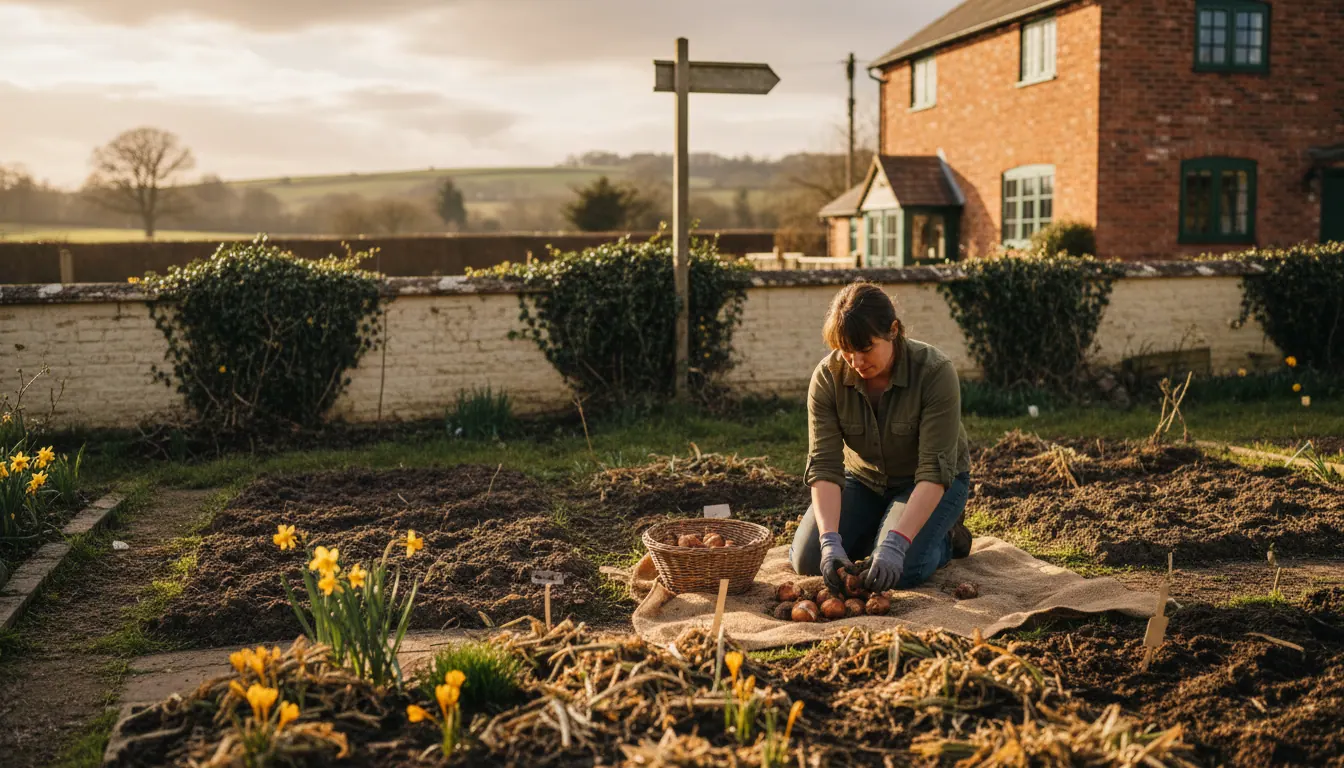
How do I plant tulips properly? Dig a hole roughly 15cm deep (about three times the height of the bulb). Place the bulb pointed end up. Space bulbs at least 10 to 15cm apart. Backfill, firm gently and water in. In heavy clay soils around Newark, add a handful of grit beneath each bulb to improve drainage and reduce the risk of rotting. Wait until late October or November to plant tulips specifically, to lower the risk of tulip fire disease.
How many tulip bulbs should go in one hole? One tulip bulb per hole is standard. Unlike smaller bulbs such as crocus or muscari, tulips need space for the roots to develop and for air to circulate. Crowding them increases disease risk. For a full, lush display, plant more holes closer together rather than cramming multiple bulbs into one.
Are there any bulbs that can be planted in spring instead? A few. Begonias, dahlias and gladioli are all planted in spring (April to May) once the risk of frost has passed. These are tender bulbs and corms that would not survive a Nottinghamshire winter in the ground. If you missed the autumn window for spring bulbs entirely, snowdrops are sometimes sold "in the green" in late winter and can be transplanted successfully at that stage.
Get Your Garden Ready for a Strong Spring
If you need a hand with autumn border clearance, leaf collection or general garden preparation across Newark-on-Trent, Nottinghamshire and the surrounding villages, we are here for it. We are fully insured, we take all garden waste with us, and we work to a standard we are genuinely proud of.
Call us on 07704 442169 and we will talk through what your garden needs before winter sets in.
“Great service and a fantastically tidy garden 👍🏼”